
The Dip-Buying Generation: What Happens When Everyone Expects a Recovery?
Self-directed investors have more tools, more information, and more ways to increase market exposure than ever before...

by Robert Koloshuk, CIO
The market's composition has changed. Self-directed investors have more tools, more information, and more ways to increase market exposure than ever before. But as buying the dip becomes second nature, what happens if the capital supporting that behaviour runs out?
There was a time when the self-directed investor was relatively easy to dismiss.
They were the discount brokerage customer. The do-it-yourself investor who preferred managing their own money rather than paying an advisor. Often characterized as inexperienced, speculative, and prone to emotional decision-making, retail investors were generally thought of as followers of markets rather than meaningful drivers of them.
That characterization is increasingly outdated.
Today's self-directed investor has access to an extraordinary amount of information, investment products, analytical tools, and market commentary. With a smartphone and an internet connection, an individual can research companies, compare ETFs, examine institutional holdings, monitor economic developments, and execute sophisticated investment strategies.
Artificial intelligence is accelerating this transformation further. But perhaps the most consequential change isn't the information investors can access. It's how their collective behaviour may be influencing the markets themselves.
For decades, financial advisors have emphasized the importance of helping clients remain disciplined during periods of volatility.
“Time in the market beats timing the market.” “Stay the course.” “Buy low, sell high.”
An entire generation of investors has now grown up hearing these principles. From Millennial Bitcoin holders to Gen Z investors purchasing all-in-one ETFs, the conventional wisdom surrounding long-term investing is no longer confined to the offices of financial advisors.
Increasingly, investors aren't panicking when markets decline. They're buying.
And evidence suggests this behaviour is considerably more widespread than previously understood.
A 2026 academic working paper, Buying the Dip in Retail Trading, analyzed data covering approximately 80% of actual U.S. retail trading activity between 2017 and 2024. Researchers Xiao Yin and Dongchen Zou documented systematic dip-buying: retail order flow increased markedly following price declines, but was comparatively flat following gains.
Meanwhile, Citadel Securities reported that in the first half of 2026, retail investors purchased nearly 3.5 times the average daily amount on S&P 500 down days in its dataset. Charles Schwab's fourth-quarter survey found that 84% of its surveyed active traders were at least somewhat likely to buy a notable market dip.
These figures do not prove that every self-directed investor behaves alike, nor that buying after a decline necessarily represents excess risk-taking. They do, however, suggest that buying the dip has become an observable feature of contemporary retail trading.
One interesting place to observe this evolution is Blossom Social, a Canadian-founded investment community that combines market discussions, linked brokerage accounts, portfolio information, and educational content.
Unlike a general-purpose social network, Blossom offers a window into how an engaged group of individual investors is actually thinking about markets. Its users are not necessarily representative of the broader investing population, but their conversations can be revealing.
Following the November 2026 selloff, Blossom CEO and co-founder Maxwell Nicholson highlighted the platform's trading activity, writing: “77% of Blossom net-buying this week!” The figure is his reported community measure, not a population-wide estimate.
In another discussion, a user asked a remarkably direct question: “Who's about to use margin to buy the dips?”
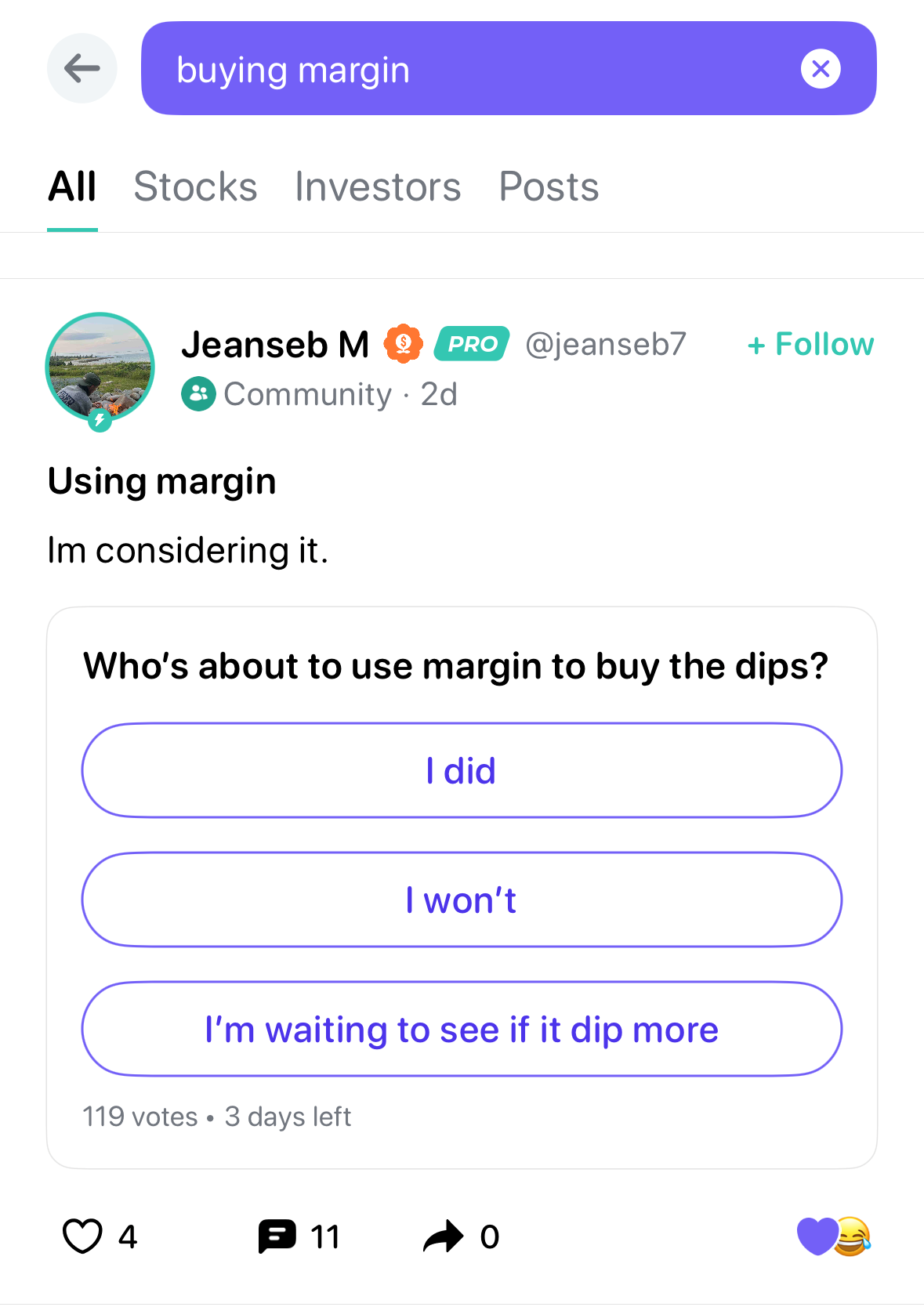
On its own, the poll provides no scientific evidence of a surge in margin borrowing. Nevertheless, it captures an important shift in the conversation: not simply whether to purchase declining markets, but how to finance additional purchases.
There is nothing inherently irrational about adding to investments when prices decline. An investor with a long time horizon, a diversified portfolio, and available cash may reasonably conclude that lower prices present an attractive opportunity.
But there's an important distinction between deploying available capital and progressively increasing risk exposure to recover previous losses.
Imagine an investor who responds to a 10% decline by investing cash reserves. After a further decline, they borrow against their portfolio. If prices fall again, they switch part of their equity allocation from an ordinary ETF into a daily leveraged ETF. At each stage, market exposure increases in anticipation of a rebound.
That behaviour starts to resemble elements of a Martingale strategy: increasing the size of one's exposure following losses in the hope of recovering them. Not every dip purchase is Martingale, and not every use of leverage is imprudent. The crucial issue is the assumption that capital and borrowing capacity will be available throughout a prolonged drawdown.
The strategy may fail before the anticipated recovery arrives.
And today's investors have more accessible ways to increase exposure than ever before. Margin accounts, options, and leveraged ETFs allow investors to magnify their sensitivity to market returns without committing an equivalent amount of cash.
Leveraged ETFs typically seek a multiple of their underlying benchmark's daily return, not its return over an extended holding period. Compounding can produce significantly different outcomes, particularly during volatile or sideways markets.
As documented by Colby J. Pessina and Robert E. Whaley in their 2021 Financial Analysts Journal study, the interaction of leverage, volatility, compounding, and benchmark structure creates risks that are not always intuitively understood. Some leveraged equity products have performed very well during persistent bull markets; others have suffered severe losses in different environments.
Higher exposure does not change the fundamental economics of the underlying asset. It changes how quickly an investor's capital responds when the expected path fails to materialize.
An entire generation has experienced major market selloffs followed by substantial recoveries. The global financial crisis, the COVID-19 selloff, and subsequent periods of volatility helped reinforce the perception that equity corrections are temporary interruptions to a persistent long-term upward trend.
There are legitimate reasons why equities have historically generated positive long-term returns: investors require compensation for bearing risk, corporate earnings can grow, and reinvested dividends and productivity gains can help compound wealth.
But those economic fundamentals are not a guarantee that prices will quickly recover to their previous highs.
Eugene Fama's foundational 1970 paper, Efficient Capital Markets: A Review of Theory and Empirical Work, provides an important distinction. In an informationally efficient market, past price movements alone should not reliably offer abnormal risk-adjusted profits. A selloff is not, by itself, proof that an asset is undervalued.
“The market is down; therefore, it must be a good time to buy.”
The intuition is understandable. Yet market prices reflect expectations for future earnings, discount rates, and risk. A decline may represent a temporary dislocation - or a rational reassessment of future profitability.
Measures such as the cyclically adjusted price-to-earnings ratio (CAPE) can help contextualize valuation, although CAPE can remain elevated for years and its historical average is not a fixed fair-value target. Interest rates, margins, market composition, and risk premiums all matter.
The important distinction is between buying because valuations have become more attractive and buying solely because the market has recently declined.
Now consider what happens when millions of investors independently adopt similar behaviour.
During an ordinary correction, investors with available cash may absorb shares being sold by other market participants. That incremental demand can support prices and help markets find a new equilibrium.
Yet the capacity to keep buying is not unlimited.
Some investors use cash reserves. Others redirect new savings, rebalance portfolios, or borrow. Each source has constraints, especially if declines persist while household finances or credit conditions deteriorate.
Investors who purchase aggressively after the first 10% decline may have less available capital after the second. Those using margin may face higher financing costs, reduced collateral values, or forced deleveraging.
It's important not to mistake a plausible market mechanism for a proven prediction. Retail investors are not the only source of buying demand, and there's no evidence that every major repricing must wait until dip buyers have exhausted their capital. Corporate buybacks, institutions, passive flows, market makers, and systematic strategies all shape market liquidity.
Nevertheless, the 2026 Yin-Zou research offers a thought-provoking result: its calibrated model predicts that growing retail participation can amplify volatility during declines, even though retail investors tend to buy into falling markets. The prediction is model-based; it is not proof that this mechanism will dominate the next selloff.
Consider two hypothetical market environments.
Markets fall, investors deploy available cash, selling pressure eases, and prices recover. Buying the dip is rewarded, reinforcing the belief that the next decline should also be purchased.
Earnings expectations weaken, valuations contract, and prices continue to fall. Cash balances diminish, risk tolerance is tested, and leveraged investors may need to reduce rather than add exposure.
The second scenario does not require every investor to capitulate. It only requires a meaningful change in the balance between marginal buying demand and selling pressure.
This is not a prediction that such an event is imminent. It is a reminder that market liquidity is a function of both willingness and ability to transact.
For financial advisors and investment professionals, the implications are worth considering. The old assumption that individual investors need constant reminders not to panic may no longer describe a substantial segment of the self-directed investing population.
Many investors understand the benefits of long-term participation. They are comfortable with volatility and have access to sophisticated investment products. But greater access to information doesn't necessarily translate into a complete understanding of portfolio risk.
The more useful conversation may be about the distinction between long-term expected returns and the path markets take to deliver them. Markets can remain below previous peaks for extended periods. Valuation multiples can contract even while earnings grow. Borrowing can force an investor to reduce exposure at an unfavourable time.
The real risk may not be that today's investors panic too quickly. It may be that they have become too confident they will never need to.
The democratization of investing has expanded access to markets and investment information. That is a welcome development. But as market participation evolves, so too can the mechanisms that support, or destabilize, prices during stress.
Buying the dip has worked often enough that many investors now treat it as a natural response to volatility. That behaviour may continue to support markets through ordinary corrections.
Yet a strategy built on the expectation of a relatively rapid recovery is different from a portfolio designed to withstand a recovery that takes years, or arrives in a different form than investors expect.
For us, this is an argument for thinking carefully about risk concentration, leverage, liquidity, and diversification across genuinely different sources of return. An all-weather philosophy begins with the recognition that no single market narrative is guaranteed to persist.
Believing markets will eventually recover and constructing a portfolio capable of withstanding the journey are two different things.
Because the most important question may no longer be whether investors are willing to buy the next dip.
It's what happens when they can't.
IMPORTANT DISCLOSURES: This commentary is provided for informational and educational purposes only and does not constitute investment advice, a solicitation, or an offer to buy or sell any security. Opinions reflect the author's views as of the publication date and may change without notice. Research findings, surveys, and illustrative scenarios are not predictions of future market performance. Leveraged investments may amplify losses. Past performance is not necessarily indicative of future results. All investments involve risk, including the possible loss of principal.
Self-directed investors have more tools, more information, and more ways to increase market exposure than ever before...

In Q2 2026, the WaveFront All-Weather Fund returned +4.70%, outperforming its Benchmark by +248 basis points...

As markets stretch between fear and euphoria, one of Canada’s longest-standing liquid-alt managers shares how Alternatives add true diversification.